Showing posts with label calla lily. Show all posts

Thursday, October 17, 2013

Letter from Taiwan

Temple dragon in Taichung, Taiwan
This temple dragon near Taichung's Botanical Gardens faces a convenience store across the lane

In public spaces here in Taiwan I frequently see jungle geraniums used as shrubs, squared off as if they were boxwood. I have found vertical gardens in both commercial and park settings, living walls indoors and out. I have witnessed orchid foliage and roots attached to trees along a city street in Taichung and orchids in bloom holding on to temple garden trees above Sun Moon Lake.  In a Taipei park I discovered the name of a flowering perennial that blooms wild in my Lowcountry front yard late each August: zephyr lily. Also in Taipei, I attended a bonsai exhibition and was reminded of the tiny pine I'm growing in a styrofoam cup at home,  reminded that I need to be more proactive in mapping out its growth. I've come across tree roots that look like a map of unexplored territory. I've visited a flower market, which turned out to be more like a series of connected plant nurseries rather than the florist mecca I imagined. I've enjoyed the perfume of plumeria blossoms. I've walked among treetops in the Xitou Forest Recreation Area and seen tree ferns that delighted the eye. And I'm not done yet. One day soon I'll visit Taichung's Botanical Garden. Perhaps as early as this afternoon.


Angel's Trumpet
Angel's Trumpet growing near an ancient red cypress tree in Xitou Forest Recreation Area
Why don't my angel's trumpets thrive like this?

Inside a vendor's tall at Taichung's Flower Market

Bougainvillea
Bougainvillea galore

Also at the Flower Market

Downtown Taichung
A segment of the Calligraphy Greenway in Taichung

Calla lily with spider at Xitou Forest Recreation Area
Calla lily with spider at Xitou


Changhua, Taiwan
A lovely tableau in Changhua


Hibiscus at Xitou Forest Recreation Area

A living wall inside a Taichung shopping mall

Orchid attached to tree, Taichung, Taiwan
Orchid attached to tree

Plumeria blossom
Plumeria blossom

Shopping mall exterior in Taichung

Xitou Forest Recreation Area

Tree fern at Xitou
Tree fern in Xitou

Zephyr lily
Zephyr Lily grow in a Taipei park

Tree roots at Shueili Snake Kiln in Taiwan
Amazing tree roots at Shueili Snake Kiln


Luxuriant hibiscus growing near Sun Moon Lake


Bonsai
At the Bonsai Exhibition in Taipei

Taipei Expo Park

Ginger
Ornamental ginger at Syuanguang

The brand new Ikea in Taichung


Sunday, June 16, 2013

Journey to Sissinghurst

Ten years ago, I spent one week in London during the month of June. During that week I made day trips to Kew Gardens, Lamb House in Rye, and Sissinghurst Castle. 

From my journal, dated June 22, 2003:

At Victoria Station. Am steaming inside. Why didn't I just have a lie in and read all day? Instead, once again I've wasted time by going to Charing Cross Station first instead of Victoria. Silly me - didn't realize they were going to cancel today's run that stops at Staplehurst. So here I am at Victoria losing an hour. I'll miss the direct bus to Sissinghurst. 

But this is what adventures are all about. Or perhaps I should say this is what quests are all about - the struggle, the conflict, the repeated failures, and yet determination to succeed when it would be much easier just to give up.


Sissinghurst Castle
Sissinghurst Castle, site of the magnificent gardens of Vita Sackville-West and Harold Nicolson

My introduction to Sissinghurst Castle came late in 1990 while perusing the November issue of HG, the now-defunct American version of House & Garden magazine. The issue included an article by Nigel Nicolson about the renowned garden created by his parents, the writers Vita Sackville-West and Harold Nicolson. 

The garden has evolved since its origin in the 1930s. In his article "Sissinghurst Grows Up," Nigel Nicolson wrote "The garden changes because we do not slavishly replace a plant that dies with the same plant in the same place." 

On June 22, 2003, I disembarked from the train at Staplehurst Station, located an open taxi stand but decided, after the long ride, to visit the loo before arranging transportation out to Sissinghurst. I retraced my steps to find the nearly hidden sign for the ladies room. Once inside, I saw a urinal and wondered how I managed to end up in the wrong room. It reminded me of a morning a few years earlier when at the Raleigh-Durham airport I came upon a man in the ladies room. A victim of poorly placed signage, the man stood inside a toilet stall, door open, with his back to the restroom entrance. His eyes widened when, turning as he zipped up, he saw me enter the room. I imagine that in that instant he comprehended why this airport restroom had no urinals. 

At Staplehurst Station I almost backed out of what must have been the men's room, but having the chamber to myself, I instead opened a stall wherein I found a half-eaten chili dog perched on the toilet tank. I averted my eyes and held my breath, reminding myself how far I'd come to get there.

A moment later, back outside, I discovered that the taxi stand had closed during my brief absence. After noting the phone numbers posted on the door, I walked to a pay phone at a nearby car park, dropped in the appropriate coins and dialed. The dispatcher who answered the call assured me a car would pick me up in approximately fifteen minutes. 

While waiting inside the station, I noticed two men peering into the glass windows of the taxi stand. One pointed to the phone numbers and pulled out his mobile. A moment later the station door opened and, walking in, he asked if I had ordered the taxi and would I consider sharing the car to Sissinghurst. I told him I'd be happy to have company. 

As we waited together I learned that the two men also had expected to take the train out of Charing Cross, the usual point of origination, and like me had to travel to Victoria, thereby missing the 10:32 train as well as the direct bus from Staplehurst Station to the gardens. 

Both of the men spoke with British accents but one told me he lived and practiced law in San Francisco. Earlier I had heard them asking each other getting-acquainted questions. During our ride to Sissinghurst Castle, the "American" one gallantly attempted to include me in conversations, but captivated with the countryside passing outside the taxi window I left them to their courtship. When we arrived at our destination, the San Francisco resident generously insisted on paying the full fare rather than splitting it as our driver had suggested and as I had expected we would do.    

Once inside the grounds of Sissinghurst, my only complaint was that I had to share the magnificent garden rooms with so many other people - this in spite of the fact that, because of rain, the gardens had fewer visitors than usual. 

The property's current owner, the National Trust, provided a map that guided me to the rose garden, the herb garden, the nuttery, the cottage garden, and the famous White Garden. That afternoon I saw masses of calla lilies, acanthus, yellow columbine. Brick walls served as the backdrop for roses and other ornamentals. The garden rooms were, if anything, even more lush than portrayed in the HG photographs or the written accounts I had read prior to my trip. I found the White Garden breathtaking - something like a giant bridal bouquet with a soft lacy effect. 

Harold Nicolson, as garden designer, put the technique of framing to good use. Ten years on from my trip I still remember admiring the vistas I came upon as I strolled through the garden rooms. Canopies of trees framed three sides of a statue; a stand of ferns provided the bottom of the frame. Was this something Harold Nicolson planned? Or the later work of National Trust horticultural employees? 

Always while visiting the great gardens there is much to see, yet not enough time. I take photographs, not only to remember, but so that I can discover later what I overlooked on site. On this day I had only a film camera and evidently a single roll of print film. As a result, I have far fewer pictures of Sissinghurst than I would have if I had then owned a digital camera.

In Sissinghurst's gift shop I bought a tan National Trust backpack, Vita Sackville-West's novel All Passion Spent, a collection of her newspaper columns entitled In Your Garden Again, and a children's book The Great White Owl of Sissinghurst written by the late Dawn Langley Simmons, an interesting and controversial former resident of Charleston. 

Later while awaiting the train that would take me back to London,  paging through In Your Garden Again, I located Sackville-West's June 22, 1952 newspaper column, published in The Observer exactly fifty-one years prior to the day of my excursion. Sackville-West wrote about herbaceous peonies, sharing the secrets to growing them successfully. In closing she noted that the peonies will "...probably outlive the person who planted them, so that his or her grandchild will be picking finer flowers fifty years hence." 

Did I see peonies in the garden? Sitting there at Staplehurst Station, I wished I had noticed. 

For information about Sissinghurst, visit the website of the Britain's National Trust: http://www.nationaltrust.org.uk/sissinghurst-castle/.

For some ideas of what to plant in your own version of a white garden, take a look at Dreams of White Gardens

Wednesday, May 15, 2013

National Public Gardens Day at Magnolia Plantation

Magnolia
Magnolia blossom at Magnolia Plantation


Last Friday, May the 10th, Magnolia Plantation participated in National Public Gardens Day, offering free admission to visitors who printed out a coupon available on-line. I've never seen such a throng of people in Magnolia's gardens, but then I've never before visited during a major event. In times past when I've been there, it's been during the colder months when more camellias are in bloom.


Magnolia Plantation, located on the Ashley River in Charleston, South Carolina, is one of America's oldest gardens. It's reported to be the first home to azaleas in this country. The plantation was established in 1679. During the first half of the nineteenth century, John Grimké Drayton inherited the property and expanded its gardens, enhancing the native landscape.
Lord Ferndale deep red ancient camellia japonica
The deep red flower of a Lord Ferndale ancient camellia japonica

Magnolia Plantation and Gardens includes a small formal garden, a biblical garden, a camellia garden, an oak avenue, a wildlife observation tower, a horticultural maze, and a petting zoo. By paying additional fees, visitors can tour the house, take a boat ride, and visit the Audubon Swamp Garden.

Red Bridge at Magnolia Plantation
The Red Bridge


What I like best about Magnolia Plantation is the scenic beauty of bridges over small lakes inhabited by native alligators. I enjoy hearing peacocks call and I love seeing the colors, forms, and textures of camellias and azaleas and a variety of other flowering plants.

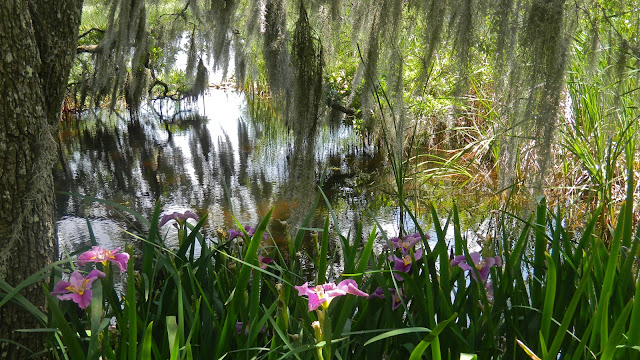
Irises and Spanish moss
Foxgloves
Foxgloves
Azalea at Magnolia Plantation
Azalea blossoms reach toward the sky

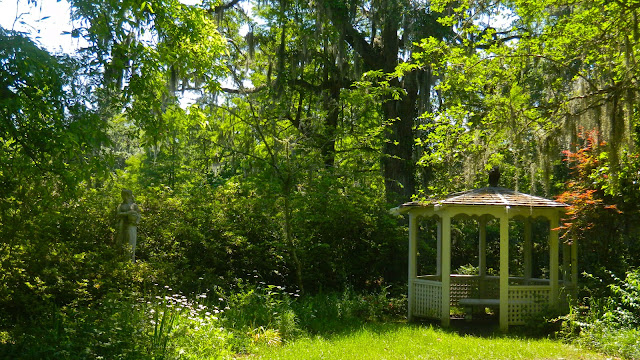
Not long after my arrival at Magnolia Plantation on Friday, I located a secluded gazebo in the Romantic Garden. Seated on a bench inside it, sheltered from the hot sun, I gazed out at patches of shasta daisies, their white faces stretching skyward. A few azaleas continued to bloom and one, within reach, had huge blossoms, colored a deep pink. A Japanese maple stood next to the gazebo and a magnolia behind it. Along the path in front of the structure, Spanish moss dangled from branches. Nearby, a pair of cardinals tweeted from a dogwood tree. 

One of the bridges at Magnolia Plantation
One of several bridges

After enjoying the view from the gazebo, I strolled through the gardens and wandered down the path between the historic rice fields and the Ashley River, remembering the time, well over twenty years ago, when I pushed my niece's stroller down these same paths. 

Was that before or after Hurricane Hugo devastated the area? Probably before. But I recall returning after and how thinned out this and other area gardens appeared during the months and first years that followed the storm. 

Now the growth is lush again. I'm thankful for that and for the offer of free admission that provided the incentive to travel once again to a place I visit far too seldom.

A trio of calla lilies
Garden visitors
Visitors stroll through the gardens
Gazebo
Gazebo in the Romantic Garden


For more information about the gardens at Magnolia Plantation, visit:

Magnolia Plantation