Showing posts with label South Carolina. Show all posts

Sunday, June 29, 2014

A Detour


Rose in bloom at Edisto Memorial Gardens
One of the many varieties of roses on display at Edisto Memorial Gardens

Earlier this month while driving to Columbia to spend the afternoon browsing in unfamiliar libraries and give an evening poetry reading, I detoured off I-26, heading south on US Highway 301 to visit Edisto Memorial Gardens in Orangeburg, South Carolina. High levels of contrast in lighting (not ideal for photography) accompanied my impromptu midday visit, but at least I was present. For many years, I'd planned to stop by, but never seemed to manage to get there. 


Edisto Memorial Gardens
Wander down the boardwalk

My first visit to Edisto Memorial Gardens occurred in the spring of 1979. We were traveling up US 301 on our way from South Georgia to Union Grove, North Carolina. Azaleas might have been flowering but I don't recall seeing them. I just remember wanting to return when the roses were in bloom. 

"Heart O' Gold" rose at Edisto Memorial Gardens
"Heart O' Gold" grandiflora rose

"Pink Promise" rose at Edisto Memorial Gardens
"Pink Promise"hybrid tea rose

"Carefree Delight" roses at Edisto Memorial Gardens
"Carefree Delight" shrub rose
When I saw the exit sign on June 11 of this year, it occurred to me that the time was right. Roses would be blooming. What I didn't realize was that I'd get to see not only a large selection of roses, but a wide variety of daylilies, as well.


Edisto Memorial Gardens


Daylily growing at Edisto Memorial Gardens
Unidentified daylily
"Pretty Blue Eye" daylily
Edisto Memorial Gardens
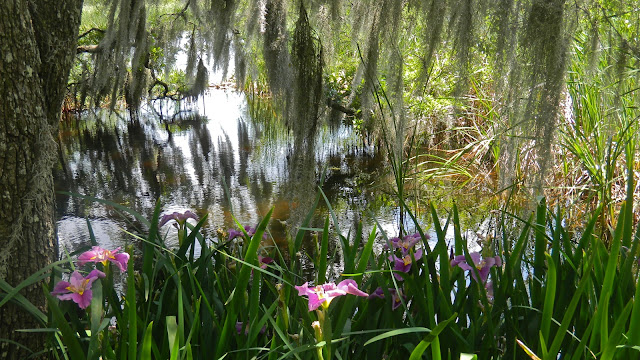
Stroll past daylily beds and dangling Spanish moss and head to a romantic bench

For more information about Edisto Memorial Gardens, visit: http://www.orangeburg.sc.us/index.php?option=com_content&view=article&id=21&Itemid=70


Rose beds at Edisto Memorial Gardens in Orangeburg, South Carolina
Sit back and enjoy the gardens


Friday, November 29, 2013

Lowcountry, Late Autumn


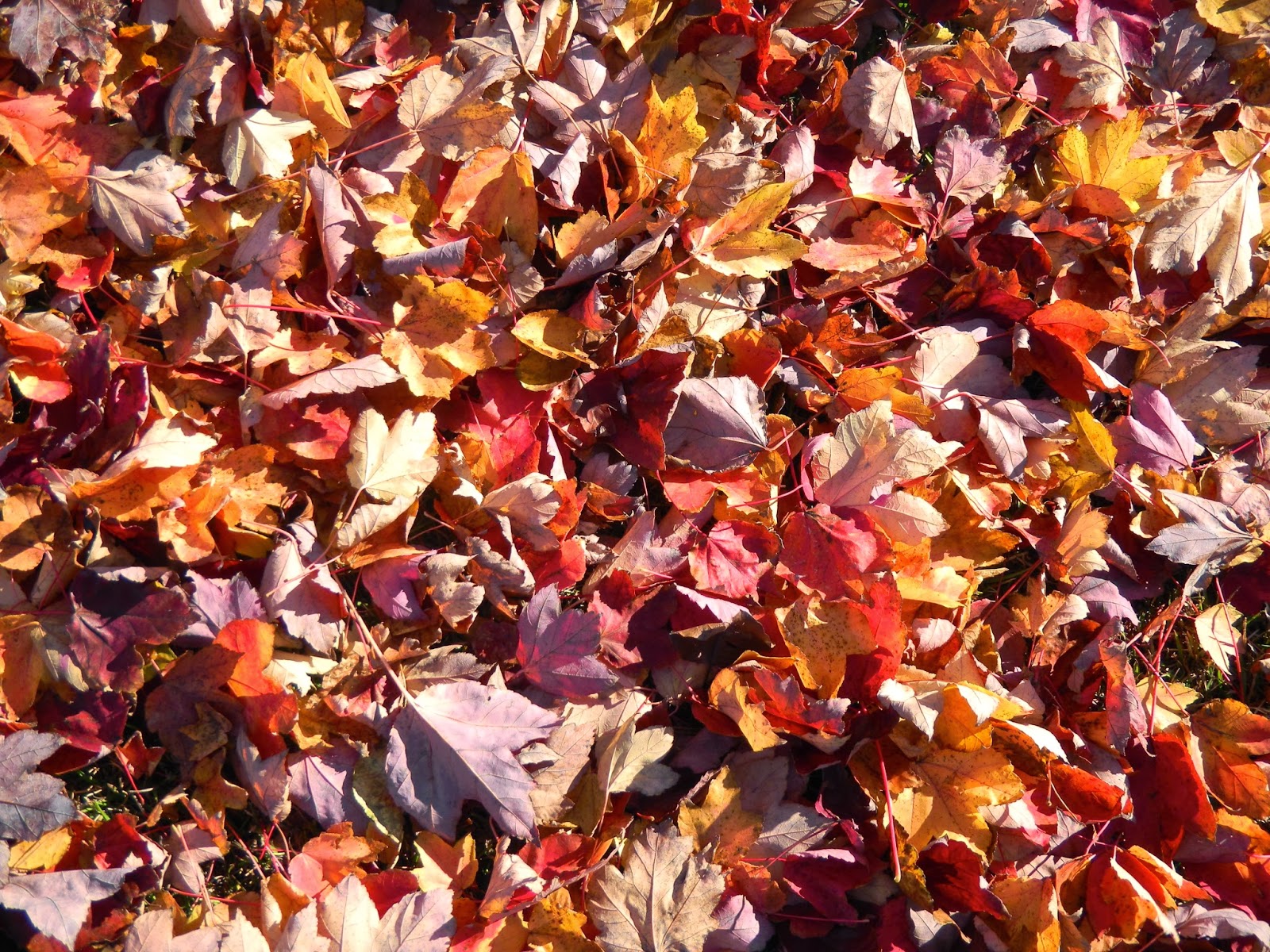
fallen leaves
Fallen leaves
With all the extra rain that descended on the Lowcountry during the summer of 2013, I wondered whether we would get a higher degree of fall color than usual this year. I'm no botanist, but I've observed more brightly colored leaves here this month than in any other November since moving to the area more than two decades ago.
Japanese maple and palm fronds
Yellow maple leaves
When I think of autumn in the Lowcountry, I think of Spanish moss dangling from live oaks and of the marsh with its spartina grass turned the color of ready-to-harvest wheat. In the wild, scarlet Virginia creeper and the bright yellow leaves of wild muscadine garland trees and anything else they manage to climb. Dogwoods always provide a bit of color before dropping their leaves. This year I'm noticing more maples and ornamental fruit trees displaying vibrant colors. And I'm loving it.

Mount Pleasant flora
Near creeks and rivers this is what November looks like in Mount Pleasant
Spanish moss dripping from live oak
A typical Lowcountry autumn scene: Live oak dripping with Spanish moss
Vibrant leaves
This year trees display more vibrant leaves than usual
Dried leaves
…but there are plenty of just plain brown leaves on the ground
Virginia creeper, bright red
Virginia creeper can be counted on to add brilliance

Friday, May 31, 2013

A Wild and Peaceful Garden

Tower of the Unitarian Church of Charleston
Charleston's historic Unitarian Church
Almost exactly twenty-six years ago I moved to the Lowcountry and embarked on a career in accounting. The first firm I worked for had its offices on King Street in Charleston. An adjacent path ran from King to the cemetery of the Unitarian Church located on Archdale Street. When things got stressful, as they do in the deadline-driven world of accounting, I sometimes headed outside to walk. That's how I first discovered this distinctive churchyard garden. 

Blue plumbago and pale pink roses
Blue plumbago and pink roses


What I love about the Garden of Remembrance is its riotous vegetation. How can I feel guilty about the untidiness of my own garden when here I see the dazzling communion of weeds and cultivated plants?

Lilies
Lilies mingle with weeds

In 1989 Hurricane Hugo overwhelmed Charleston. Its winds removed the roof from one of the two buildings that housed the accounting firm. The roofer got to work quickly, but not until after photographs were taken to document the extent of damage. I remember seeing the pictures during those first terrible days when the whole world seemed to have turned upside down, a time when armed members of the National Guard roamed the streets and a nearby restaurant cooked chicken outside on a grill because electricity hadn't yet been restored. How ludicrous it all seemed. Those photographs captured an unusual view: in the foreground, file cabinets stood in the roofless attic; in the background, blue sky and the tower of the Unitarian Church dominated.

Garden of Remembrance

Most often when I think of this church, I think of its cemetery garden. I think of the gift of serenity -- of being allowed a chance to calm down before returning to a less-than-peaceful world. 
Red canna
Canna lily


For more information about the Garden of Remembrance, visit the  Unitarian Church of Charleston's website:

Wednesday, May 15, 2013

National Public Gardens Day at Magnolia Plantation

Magnolia
Magnolia blossom at Magnolia Plantation


Last Friday, May the 10th, Magnolia Plantation participated in National Public Gardens Day, offering free admission to visitors who printed out a coupon available on-line. I've never seen such a throng of people in Magnolia's gardens, but then I've never before visited during a major event. In times past when I've been there, it's been during the colder months when more camellias are in bloom.


Magnolia Plantation, located on the Ashley River in Charleston, South Carolina, is one of America's oldest gardens. It's reported to be the first home to azaleas in this country. The plantation was established in 1679. During the first half of the nineteenth century, John Grimké Drayton inherited the property and expanded its gardens, enhancing the native landscape.
Lord Ferndale deep red ancient camellia japonica
The deep red flower of a Lord Ferndale ancient camellia japonica

Magnolia Plantation and Gardens includes a small formal garden, a biblical garden, a camellia garden, an oak avenue, a wildlife observation tower, a horticultural maze, and a petting zoo. By paying additional fees, visitors can tour the house, take a boat ride, and visit the Audubon Swamp Garden.

Red Bridge at Magnolia Plantation
The Red Bridge


What I like best about Magnolia Plantation is the scenic beauty of bridges over small lakes inhabited by native alligators. I enjoy hearing peacocks call and I love seeing the colors, forms, and textures of camellias and azaleas and a variety of other flowering plants.

Irises and Spanish moss
Foxgloves
Foxgloves
Azalea at Magnolia Plantation
Azalea blossoms reach toward the sky

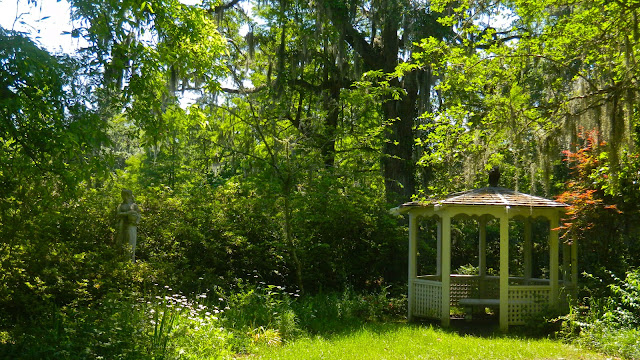
Not long after my arrival at Magnolia Plantation on Friday, I located a secluded gazebo in the Romantic Garden. Seated on a bench inside it, sheltered from the hot sun, I gazed out at patches of shasta daisies, their white faces stretching skyward. A few azaleas continued to bloom and one, within reach, had huge blossoms, colored a deep pink. A Japanese maple stood next to the gazebo and a magnolia behind it. Along the path in front of the structure, Spanish moss dangled from branches. Nearby, a pair of cardinals tweeted from a dogwood tree. 

One of the bridges at Magnolia Plantation
One of several bridges

After enjoying the view from the gazebo, I strolled through the gardens and wandered down the path between the historic rice fields and the Ashley River, remembering the time, well over twenty years ago, when I pushed my niece's stroller down these same paths. 

Was that before or after Hurricane Hugo devastated the area? Probably before. But I recall returning after and how thinned out this and other area gardens appeared during the months and first years that followed the storm. 

Now the growth is lush again. I'm thankful for that and for the offer of free admission that provided the incentive to travel once again to a place I visit far too seldom.

A trio of calla lilies
Garden visitors
Visitors stroll through the gardens
Gazebo
Gazebo in the Romantic Garden


For more information about the gardens at Magnolia Plantation, visit:

Magnolia Plantation

Thursday, January 31, 2013

Camellias in Bloom


Camellia
My late grandmother Chessie Pearce's camellia
Camden County, North Carolina
Photographed by Edward L. Pearce

This past Saturday the Coastal Carolina Camellia Society held its annual camellia show. According to the Society's FaceBook page, more than 1,000 blooms were entered. I intended to go across town to view the entries, but got busy and forgot until too late. What a great opportunity it would have been to learn more about camellias.

My grandmother, Chessie Pearce, grew a camellia tree in her garden. The tree is at least sixty-five years old but possibly much older. My brother Edward remembers our grandmother saying camellias should be planted on the north side of a pine and also remembers her calling her tree a japonica. Sometime during the 1970s temperatures dropped below zero and the freeze damaged Grandmama's tree. After Edward cut it back to about five feet, it revived. Now, forty-five years after our grandmother's death, the tree is approximately eighteen feet tall and blooms prolifically. 


Camellia tree
Chessie Pearce's camellia tree is more than 65 years old
Photographed by Edward L. Pearce

My knowledge of camellias is not extensive. I'm familiar with japonicas and sasanquas, and with camellia sinensis, the tea plant. These are not, however, the only species of camellias and after doing a bit of reading, I realize it's quite possible that some of the camellias I believed to be japonicas are not.

Here's the local conventional wisdom: Japonica blossoms make beautiful cut flowers, perfect for floating in a glass bowl indoors or in a birdbath outdoors. Sasanqua blossoms don't last when cut. 

Where I live, the sasanquas usually bloom from September to November and japonicas bloom in the winter. 


Variegated camellia japonica
This red and white variegated variety 
grows in my front yard

Camellia japonica
This cream colored camellia sporting 
a wealth of stamens grows near my front door
 
Variegated camellias
A pink and white variegated variety
 growing in my front yard

My one-third acre lot contains a number of camellias. Some, or all, of the seven that came with the house, when I bought it, had been transplanted here from Summerville when the prior homeowner moved his parents into assisted living. One of the seven budded yearly, but never bloomed, and succumbed during a cold winter several years ago. A single one of the remaining six is a sasanqua, which I've had cut back, but has resumed growth. I always assumed the other five were  of the japonica species, but after perusing the American Camellia Society's website this afternoon, I'm not so certain.


White camellia japonica
This white camellia japonica is one I bought, from a plant nursery or garden center, and planted perhaps as much as ten or twelve years ago. It's at the back of the lot and gets little sunlight. Perhaps that's why it's stingy with its gorgeous blossoms. 


My older japonicas produce seeds. In the last three years volunteers have sprouted under an old pink-blossomed tree. With varying success, I've transplanted seedlings to other spots in my yard. I've also given a few away.

When I intentionally planted camellia seeds in the past, either they didn't grow, or I forgot where I planted them and accidentally mowed them down. The seedlings are similar in appearance to those of the homely wild cherry trees that, due to bird droppings, each year produce hundreds of seedlings under my huge live oak and a variety of other shrubs and trees. 

My sister Martha Ann in northeastern North Carolina had success growing a camellia from a seed I gave her years ago. One of her animals, a goat, attempted to eat the small shrub, but now it's growing back.


Camellia seeds and seedpods
This past August I harvested seeds from the five older japonicas
I have not yet taken on the task of identifying the varieties of my camellias. Nor have I been a particularly good steward of them in the past. I hope to remedy that.


Formal double camellia in South Carolina
On the grounds of the Berkeley County
Library, Daniel Island, SC
Formal double camellia growing in Japan
On the Rokko Island greenway, Kobe, Japan


As a result of having family members living in Japan, I have been able to view camellias in bloom at Tenryū-ji and other gardens in Kyoto, as well as, in and around Kobe. 


Camellia tree Kobe, Japan
One of a group of camellia trees growing out of rock
 on a hillside above Kobe, Japan in late November

There are plenty of opportunities to see camellias blooming in the American South. At this time of year a stroll through older neighborhoods, such as the one where I live, is a treat for a camellia lover. 

Two weeks from today, Middleton Place begins its annual guided Camellia Walks. Botanist Andre Michaux is said to have introduced the camellia japonica there around 1785. 

Camellia tree
This japonica by my laundry room thrives on afternoon sunlight but needs some TLC


Camellia seed pods and pear in situ
Seed pods in situ
Transplanted camellia seedling
A volunteer that I transplanted

Camellia tree at Tenryu-ji in Kyoto, Japan
April at Tenryū-ji temple gardens in Kyoto, Japan
Camellia blossom in Kyoto, Japan
A leaf wants to hide this pretty pink blossom at Tenryū-ji

Variegated camellia at Tenryu-ji in Kyoto, Japan
A variegated blossom at Tenryū-ji 

Camellia blossom

This one grows by my laundry room


Thank you for visiting The Traveling Gardener. 
Your comments are welcome.