Saturday, June 30, 2012

The Cupola House Gardens


Sometimes you just stumble across a beautiful garden. On a Monday morning in May, I made a detour while driving through North Carolina on US Highway 17. Edenton is home to the paternal grandmother in the novel I'm writing. In the past I had driven down the streets of Edenton in an effort to absorb the atmosphere, but I'd never gotten out and walked around. On that Monday last month I parked the car and set out on foot. 


Edenton, North Carolina's Cupola House


Somehow I didn't notice the Cupola House - at least not immediately. It's located next to the library and as a lover of books and libraries I was drawn inside to browse the collection. But I didn't stay indoors long. Instead, I carried on walking around the block, admiring historic homes and the bits of garden that were visible from the street. 

A gorgeous passionflower, of a different variety from those 
I'd seen before, grew on the wall in front of one old house.

So many lovely remnants of the past and so many charming gardens. What must it be like to stroll along these streets every day? 

Far right back: Pomegranate trees stretch skywards
The brilliant coral-colored blossoms on pomegranate trees in one backyard attracted my attention. I snapped a few quick photos over the fence, wondering whether the owners would mind. Then I saw the sign and realized this was the Cupola House, its colonial revival gardens open to the public. I continued around the side, gazing into the garden as I made my way toward the front entrance.  


What I love most about gardens from the American colonial era is that they combined beauty with practicality. The pleasure garden and the kitchen garden each had their place and sometimes that place was side by side, sometimes intertwined.


A brochure available in the back garden of the Cupola House provides a partial plant list. The following is but a sample of what grows in these heritage gardens: plum, crabapple, fig, loquat, dogwood, a variety of roses,  lemon balm, yellow flag iris, bluebell, foxglove, larkspur, hollyhock, garlic chives, thyme, tansy.


Yes, it was the pomegranate trees that first drew my attention to the Cupola House garden. What I didn't tell you is that in 2012 I'm having more success with my own pomegranate trees than I have in any year since I first planted them a decade ago. Three out of the four trees currently bear fruit. Seven pomegranates dangle from one tree, eleven from another, and sixteen from yet another. If all continues to go well, in the autumn I'll be spreading plenty of pomegranate love to friends and neighbors. 

The interior of a pomegranate I harvested last year from one of my own trees 

Thursday, June 14, 2012

Volunteering on the Balmacara Estate

Earlier this year I had the opportunity to participate in a conservation camp sponsored by the National Trust for Scotland.  Jon Downie, the Trust’s Outdoor Action Coordinator, led our group of ten Thistle Camp volunteers as we assisted rangers with a variety of tasks on the Balmacara Estate in the Western Highlands.


Through the gorse we go

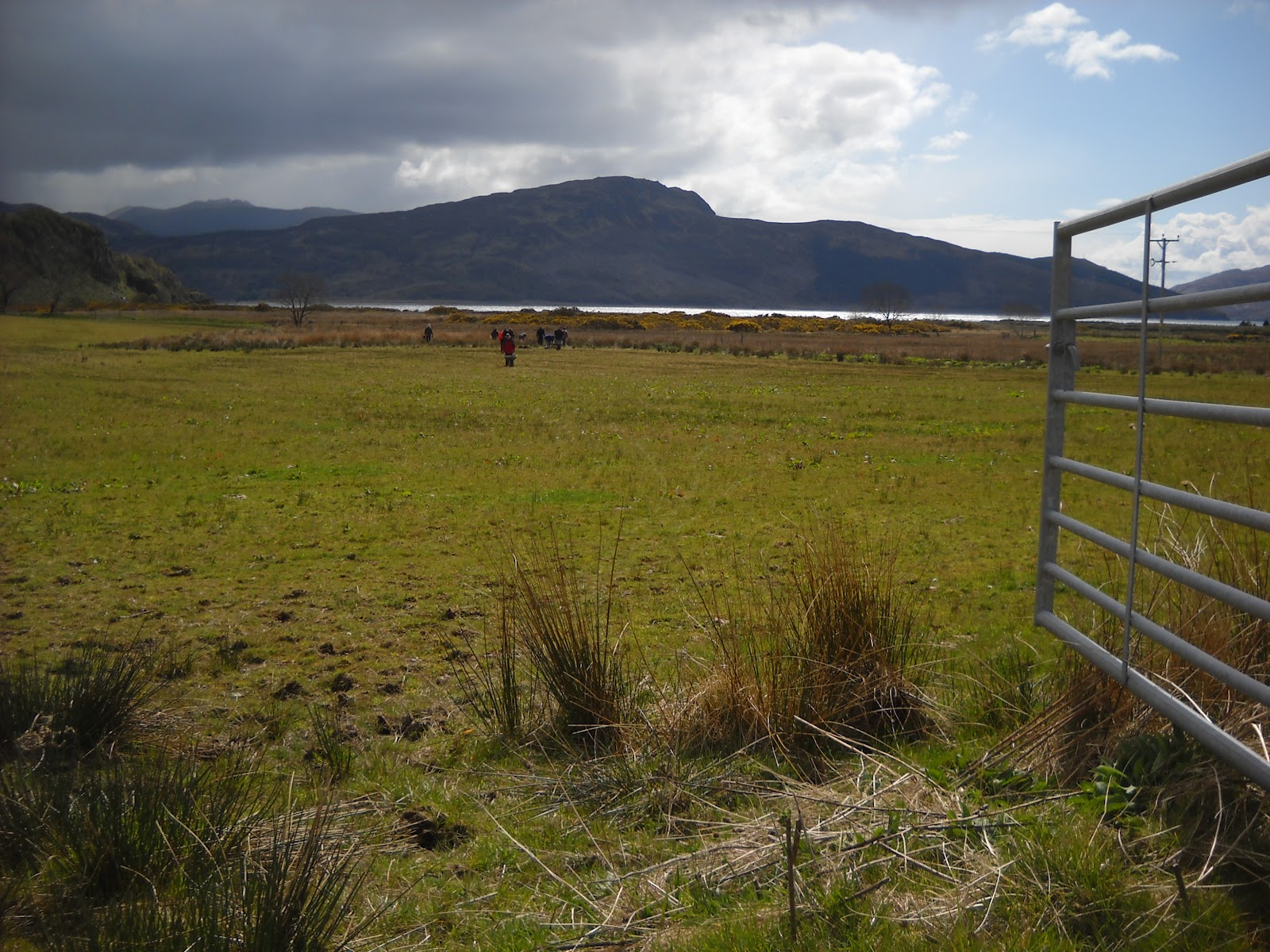
The meadow

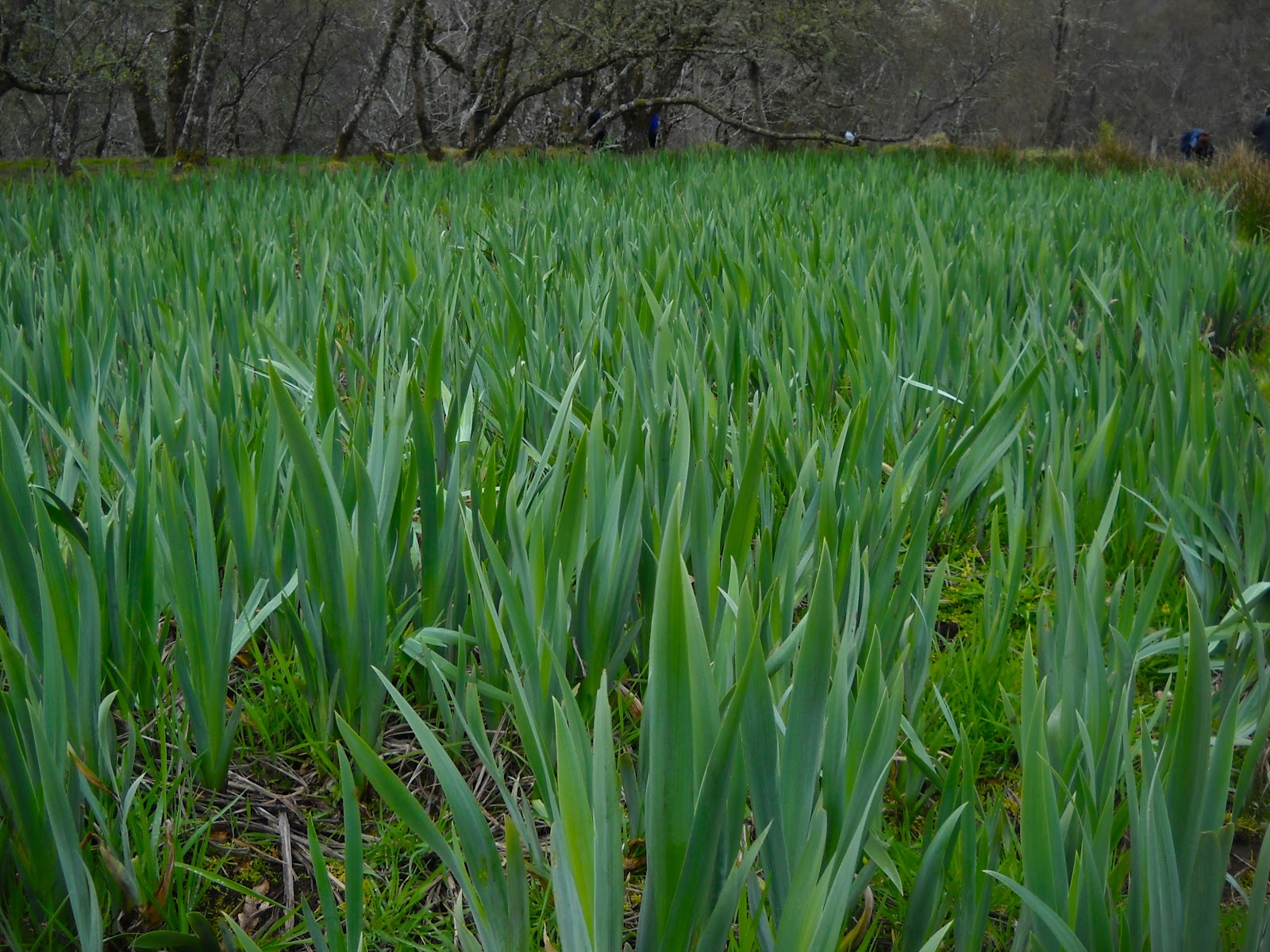
On a morning late in April we dug up yellow flag irises in a secluded meadow on the Estate. In the afternoon we transplanted them in a former pasture fronting the scenic road that goes past Eilean Donan Castle and continues on toward the bridge to the Isle of Skye. 


Digging up flag iris rhizomes


Iris transportation


Because success in transplanting irises depends upon rhizome health, Jon taught us to inspect the irises before plunging our spades into the boggy meadow. He showed us how to easily determine the position of the rhizomes so that we could limit the damage we inflicted on the plants while digging. Yet even with our diligent efforts, we occasionally lifted up spindly fans of sword-shaped green leaves with no rhizome attached.


In the middle distance, a new home for yellow flag irises
We worked hard throughout our Thistle Camp. But the most difficult bit?  Saying good-bye at the end of the week to the Highlands and to fellow team members.


The 2012 Balmacara Thistle Camp team
This photograph taken for me by NTS Ranger Babs Macritchie


To learn more about the Balmacara Thistle Camp read my August 2012 guest post on the National Trust for Scotland Foundation USA blog:

To learn more about the National Trust for Scotland's Balmacara Estate visit:

To learn more about National Trust for Scotland Thistle Camps visit:
http://www.nts.org.uk/ThistleCamps/


Thursday, May 31, 2012

Swan Lake Iris Gardens


There's something elegant about black swans. I associate them with Dawlish, the English town that serves as the fictional birthplace of Charles Dickens' character Nicholas Nickleby and with castle lakes in Germany. Black swans also reside on the premises of Sumter's Swan Lake, as do members of the other seven swan species, including the trumpet swan whose music carries magic across the water.


Copyright 2012 Frances J. Pearce
Camouflaged turtle (at top) swims toward pair of black swans


My visit to Swan Lake Iris Gardens in Sumter, South Carolina last week coincided with the town's annual Iris Festival. The festival features the Japanese iris which arrived at the lake in the first half of the twentieth century as horticultural "trash."  

I've long been an admirer of the bearded irises which thrived in my mother's garden. Dutch irises do well in my cottage garden and, just last month, I helped transplant yellow flag irises on the Balmacara Estate in the Western Highlands of Scotland.

But Japanese irises? I'd heard of them, but until last Friday I'd not experienced them, at least not in bloom. Not even during visits to Japan.

Copyright 2012 Frances J. Pearce


The gorgeous blossoms I saw in Sumter made me wish my garden would support these sun and water loving plants. I decided to take a chance. At the Master Gardener's tent I bought a plastic pot of  Japanese irises of the "Frilled Enchantment" variety. Neither these nor any of the other irises offered for sale were blooming. The lady who assisted me with my purchase explained that the mild winter seems to have affected the irises, decreasing the occurrence of blossoms. She suggested I buy a child's swimming pool to plant my Japanese iris in, but as of today, my "Frilled Enchantment" is directly in the ground in a low-lying area of my front yard. I hope to keep the soil there moist enough that a swimming pool won't be needed. And I hope I have more success with these beauties than I do with bearded irises.


Copyright 2012 Frances J. Pearce

For more information about Swan Lake Iris Gardens visit Sumter Tourism's blog: 
http://sumtertourism.wordpress.com/2012/05/18/swan-lakes-magic-rainbow/

UPDATE

"Frilled Enchantment" bloomed for me in early June of 2014.


Wednesday, May 23, 2012

Primula


Primula found among the ruins of the Viking church

One morning back in March, I spied small containers of primula displayed on a plant rack in front of the nearby Trader Joe’s grocery store. The one I bought sported deep blue flowers, the hue of its petals bordering on purple. At home, after adding the primula to a circular bed under the big live oak out front, I used a digital camera to photograph the blossoms.  The petals photographed as blue, but not the proper shade of blue, not even after I changed the settings on the camera multiple times, nor after I fiddled with the color saturation on my computer.

Still missing the hint of purple

As I sat at my computer trying to get the colors right, I remembered the pale yellow primula I spotted on an April day several years ago on the Orkney island of Egilsay. I found the primula growing wild among the ruins of the round-towered Viking church where, according to some accounts, Saint Magnus was brutally murdered in 1117.

In March when I bought the primrose, the sunshine, the chill in the air, and the wind made me feel as though I were back on Egilsay, although here in coastal South Carolina wind is less pervasive.


Primroses growing in the wild on Skye

Last month I traveled to Scotland again. This time it was near Elgol on the Isle of Skye that I came across the pale yellow primula growing in the wild.  This time the day was overcast. This time the primrose climbed hills.