Friday, August 31, 2012

A Week in Inverewe Gardens


One of the exotics growing in Inverewe Gardens

When you think of plant life in Scotland’s Western Highlands, you might visualize thistle blossoms, heather covered hillsides, or Caledonian pine forests. Unless you’ve spent time in that part of the world, you likely won’t expect to see palm trees, but palms do grow there in locales such as Plockton and Ullapool.


You’ll also find palms trees at Inverewe Gardens, near Poolewe, along with a variety of tropical and other exotic plants Osgood Mackenzie imported from locations around the world for inclusion in the garden he created 150 years ago. In spite of Inverewe’s latitude of 57.8 (for reference, Moscow’s is 55.75), the relatively warm air borne by the North Atlantic Drift makes the survival of such plant life possible. And to help shelter his plant specimens from the wind, Mackenzie established a grove of pines and had a wall erected.


After Mackenzie’s death, his daughter Mairi Sawyer continued work on the garden. In 1952 she gifted Inverewe Estate, which includes the gardens, to the National Trust for Scotland (NTS).


Two years ago I had the opportunity to spend a week living in Inverewe House while serving as a NTS Thistle Camp volunteer. I wrote about that experience in a July guest blog for the National Trust for Scotland Foundation USA. (Scroll down for link.)

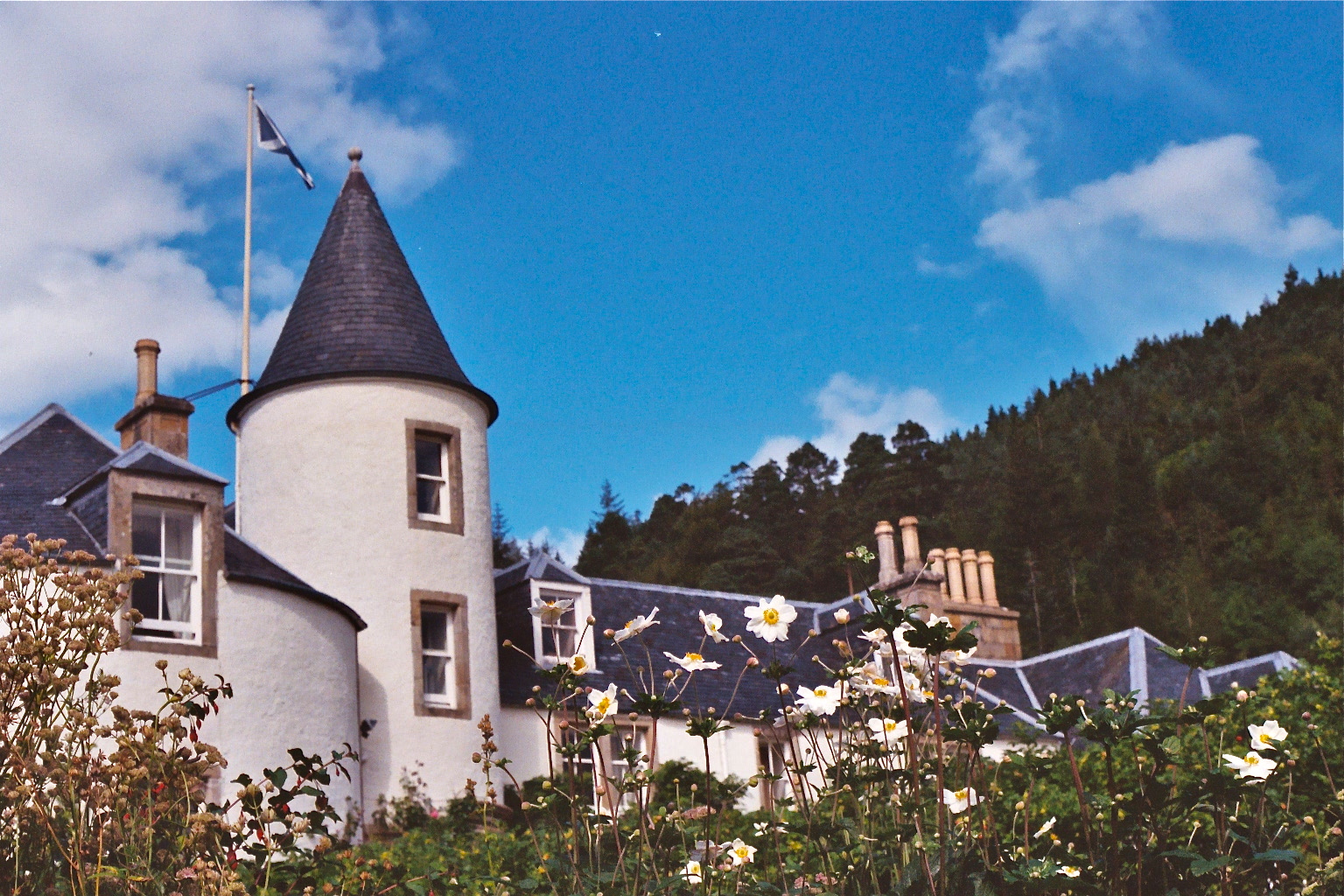
Inverewe House
Our major task as volunteers was invasive species eradication. More specifically, we did “rhody bashing,” removal of the non-native Rhododendron ponticum that had spread into the wild. We used mattocks and handsaws to remove rhododendrons that had invaded nearby woodlands and then we burned the resulting debris in bonfires.


During my stay at Inverewe House, I came upon two huge volumes of a limited edition book dated, as I recall, 1917. The volumes were filled with art plates illustrating numerous varieties of rhododendron. While turning the pages, I wondered what Osgood Mackenzie would think of the runaway rhododendrons and our efforts to try to control them. Would he approve of our work? Would he regret his decision to include this plant species in his garden?


In my own garden, I am prone to plant non-natives, as well as natives such as beautyberry. Just today I purchased a Persian Shield (Strobilanthes dyerianus), native to Myanmar, from a local garden center, not stopping to think at the time about whether this plant has the potential to become invasive here in the South Carolina Lowcountry. Already my garden includes nandina heavenly bamboo, which I planted more than twenty years ago soon after I bought this house. According to the University of Florida’s website, the State of Florida has placed nandina on their invasive species list. My garden also includes nandina volunteers, but only three or four. Although I don’t find nandina on my own state’s list, I am reminded that we gardeners need to balance our love for plants with foreign origins with the well-being of our native species.


Not all our time at Inverewe Gardens was spent battling invasive species. In the middle of the week we had a day off from volunteer activities and I spent the morning of that day wandering around the property, photographing flowers and other plants. Eventually the last of my camera batteries fizzled out. Not to be deterred, I switched to my iPhone and continued to take pictures. I’m sorry to report that I did not note the names of the various plants I observed, but I can tell you that among my favorites were the tall spiky red cannas and a gorgeous lace-cap hydrangea.
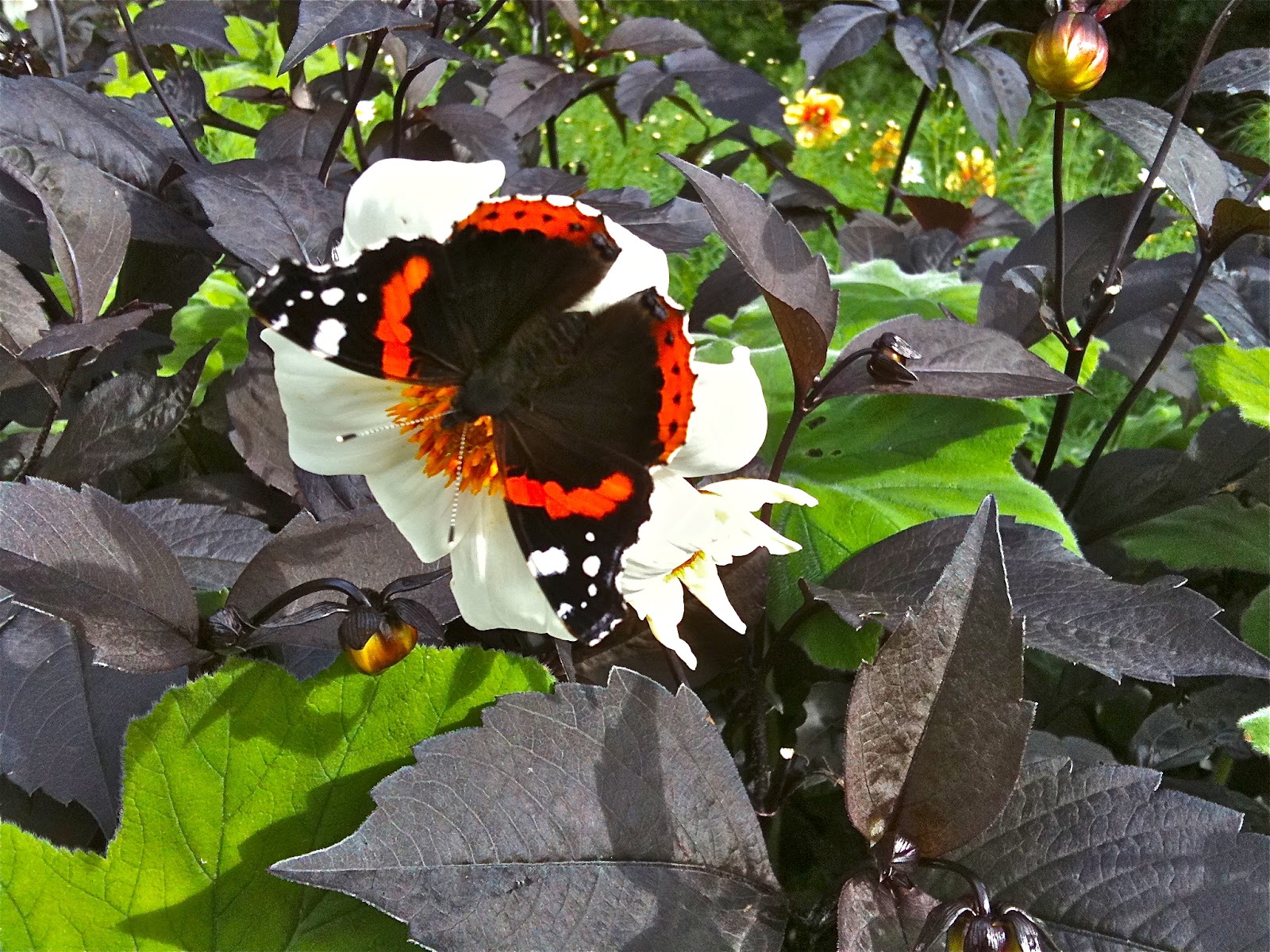


One can’t help but envy the residents of Poolewe. How fortunate they are to live near Inverewe Gardens. With its more than fifty acres and its numerous plant species, both the familiar and the exotic, this is a place a gardening enthusiast could stroll through every day of the year and never be bored. 


Loch view from the dining room

For more information about Inverewe Gardens visit the National Trust for Scotland website:
http://www.nts.org.uk/Property/Inverewe-Garden-Estate/About/

To learn more about Thistle Camp at Inverewe Gardens read my blog post on the National Trust for Scotland Foundation USA website:
http://www.ntsusa.org/blog/guest-post-inverewe-thistle-camp/


Loch Ewe, a natural beauty

Wednesday, August 15, 2012

For the Love of Moss


My romance with moss began last year. Just weeks after the horrifying earthquake overwhelmed parts of Japan, my daughter and I visited serene TenryĆ«-ji, a Zen temple in Kyoto’s Arashiyama district where, along with throngs of Japanese visitors, we viewed Sakura in bloom. At TenryĆ«-ji’s open-air gift shop I came across a book about Zen gardens. Later, back home in the Lowcountry, I allowed my eyes to linger on each photograph in the book, Samadhi on Zen Gardens, and that is how I became aware of Tofuku-ji’s checkerboard of moss and stone.

Tofuku-ji's famous moss garden
Gazing at the photograph, I thought perhaps I’d found a solution for my front lawn with its bald places. I sought to borrow the idea from Buddhist monks and transform the shady expanse beneath my live oak with something similar. I started by pulling a patch of chartreuse-colored moss off the front steps where it grew freely as a volunteer. I moved the tiny patch to a bald area and watered it when I remembered. During times when it received sufficient water, the patch grew, but it never adhered to the soil. Often it didn’t get enough water – from me or from the sky.

This isn't where I want the moss to grow!
Next I purchased a carton of moss milkshake from a company I found on-line. The sellers are not to be blamed for my lack of success with their product because neither the clouds nor I the provided enough sustained moisture to bring to life the intentionally dehydrated mosses the seller sent.  And let’s face it, the climate here is vastly different from where those specific moss varieties thrive.

In the county library I located Schenk’s excellent book Moss Gardening and after reading his words realized that perhaps I should just encourage what grows here naturally. I began noticing places where moss grew, hidden or in plain sight.  When I carried carafes of rainwater from the barrel, where I’d captured it, to gardenias and hydrangeas I’d recently planted, I made sure to allow water to drip on the volunteer moss. And the moss is even now expanding – not as rapidly as I would like, but increasing its territory nonetheless.

Moss Gardening has a chapter entitled “In the Gardens of Japan.” It begins “Mosses invited themselves to the gardens of Japan and thereby invented moss gardening.”

Late last year I returned to Japan for another visit with my family. When my daughter asked which place I most wanted to visit, I said, “Tofuku-ji, to see the moss checkerboard.” We traveled there by train and, before locating the checkerboard, were dazzled by the brilliant red leaves of Tokufu-ji’s valley of maple trees.

A moss garden at Tofuku-ji's Abbot's Hall
The Abbot’s Hall, or Hojo, at Tokufu-ji is home to four gardens, including the particular one I longed to see. The Hojo brochure, provided with paid admission, is printed in kanji for the most part, but includes a paragraph in English.  According to the brochure, the Hojo gardens were designed by landscape sculptor Shigemori Mirei in 1939. In one garden, moss covered mounds represent five sacred mountains. The coveted diminishing checkerboard lies in the Northern Garden and there the moss stood taller than I had imagined. Feeling content, I didn’t want to leave.

Before last year, I was mostly oblivious to moss, but since then, I’ve noticed it not only in temple gardens and along wild streams in Japan, but on hillsides in Scotland, and growing unfettered between sidewalk and street near the corner of East Bay and Chapel in Charleston.

The volunteer moss continues to spread
I realize I probably won’t ever have my own moss and stone checkerboard, at least, not in my current locale, but I haven’t given up the idea of cultivating more moss.  For now, I’m encouraging moss growth one drop of rainwater at a time.


Reading List

  • Moss Gardening – George Schenk (Timber Press, Portland, 1997)
  • Gathering Moss – Robin Wall Klimmerer (Oregon State University Press, Corvallis, 2003)
  • Samadhi on Zen Gardens: Dynamism and Tranquility – Mizuno Katsuhiko and Tom Wright (Suiko Books, Kyoto, 2010)

Tofuku-ji’s Website


Tuesday, July 31, 2012

My Grandmother's Canna Lilies


“Weeds are simply not allowed to grow [in her garden],” a newspaper article, circa 1950, said of my grandmother, Chessie Pearce. The article went on to report that she “has been most generous in giving cuttings and plants to her neighbors.”    

My grandmother loved to garden. In spite of living on a small family farm on the edge of the Great Dismal Swamp in North Carolina, she managed to amass an interesting collection of flowering plants. Her cannas were among my favorites. She grew two varieties: one bearing spiky red blossoms above chocolate-tinged foliage, and the other, green-leaved, boasting bright yellow petals with orange speckles.

My red canna: a hummingbird favorite

When I was a child my grandmother’s canna lilies grew so prolifically that even extras she disposed of in a swampy area beside a wide ditch grew tall and produced flowers. Cannas hanker for rich, moist soil and she provided it.
My yellow canna

After my grandmother died, her cannas lived on.  My mother planted some beneath our living room windows. While waiting for the school bus during the autumn mornings of my teen years, I watched hummingbirds drink nectar from the red flowers.

Flash forward many years. After I bought the house where I now live, my mother dug up rhizomes from my grandmother’s cannas and gave them to me to plant. I didn’t have much success at first. The plants survived, but didn’t thrive. Some years no blooms appeared. One year, leaf-curlers attacked the canna lilies. The next year I dug up the rhizomes and moved them from my sunbaked backyard to a circular bed shaded by the live oak out front. In the new location, leaves rose from the ground; while yellow flowers rarely appeared, the red ones never did.

Over the years I gave canna rhizomes to friends. The resulting plants performed well, blooming beautifully. Clearly, my friends have less sandy soil than I do.

Two summers ago I created a new flowerbed in the backyard and transplanted several of the cannas into it. Much to my delight, both the red and the yellow cannas gained height and bloomed. Soon a hummingbird noticed the spiky red flowers.

On Rokko Island, Kobe, Japan 

What I’ve failed to mention, up until this point, is that for years and years I searched for, but did not find, cannas that looked like the ones my grandmother grew. I’m not sure why I felt the need to find their counterparts, but I did. My quest to find the red and the yellow cannas continued as I scoured plant nurseries and public or private gardens. Every summer I scrutinized cannas growing in the town where I live, and in places where I traveled, but any red cannas I saw had solid green leaves or the flowers weren’t spiky. Many of the cannas growing in public places had orange or salmon colored blossoms.

Inverewe Gardens: Tropical foliage in the Scottish Highlands

Then, in July of 2010 while visiting family on Japan’s Rokko Island, I discovered the familiar yellow canna in front of a multi-family residence. Two months later I came across the spiky red canna with the chocolate tinged leaves at Inverewe Gardens in the Scottish Highlands.

The yellow canna cultivated by a gardener
on Japan's Rokko Island
The red cannas at Inverewe Gardens, 
a National Trust for Scotland property 

Now I have in my garden a third variety of canna lily. Last year during the Charleston Horticultural Society's annual plant sale, known as Plantasia, I bought an orange flowered canna with variegated, striped leaves. My Internet research indicates this variety is called Bengal Tiger.

How I wish I could have shared the Bengal Tiger with my grandmother. She would have adored its gorgeous tropical foliage.


The foliage behind this orange canna flower belongs to the variety with the spiky red flowers.

And this gorgeous leaf belongs to the orange flowered canna shown in the above photograph.


Sunday, July 15, 2012

A Highland Garden

Each morning during late August of 2005, as I devoured poached eggs on toast and British bacon in the dining room of the Old Manse Guest House, I gazed across Loch Carron.  On the opposite side of the water, to the southeast of where I sat, lies Attadale Estate. The hues of its landscape changed often as clouds broke apart to allow the sunshine through or as mist transformed into steady rain.
The view across Loch Carron to Attadale Estate
While doing pre-trip research I had come upon the Attadale Estate website and, as a result, I knew the property included gardens open to the public and I knew of the fairly recent acquisition of a large fern collection.

If I could have walked straight across the loch from the B&B, I might have had enough stamina to get to Attadale by foot, but I had just completed six and a half weeks of radiation therapy and wasn’t fit enough to hike the more than seven miles, one way, around the sea loch.

In those days the village of Lochcarron still had a local taxi service. From the phone box in front of the village hall, I called the driver. The phone kept disconnecting and each time I reached her, I spoke at rapid speed, hoping to get across enough information to enable her to find me. When she arrived, I continued in revved up mode, but she remained tranquil and told me you can always tell when people are from town: they’re in a hurry. “On Lewis where I grew up, we say, ‘It’ll get done tomorrow – if it has to.’”
The exterior of the Estate owners' home was used
 as Major Maclean's residence  in the television series Hamish Macbeth
In 2005 I hadn’t yet converted to digital photography. My film supply was limited and I was stingy with each available 35 mm frame. As I look back through my small group of Attadale photographs, I am disappointed in the quality of the photos, but I’m even more disappointed in the omissions – the photographs I did not attempt. I clearly recall sitting in the Japanese garden, writing in my journal, and watching a white haired woman wearing tartan trousers trim a sculpted shrub. And according to my journal, “On the edge of the kitchen garden a yellow-beaked blackbird perched in a fuchsia bush and ate the fruit of the flower.” I remember walking through rows of vegetable beds.  Yet I have no photographic evidence of the Japanese and kitchen gardens.

My notes indicate a rhododendron dell and also a scenic overlook with a view of the house and the loch and the hills beyond and I recall that the grounds included a DIY/honor system tearoom as well as an area where garden visitors could purchase plants.

When a sudden rain shower erupted, I took shelter in a small geodesic dome that housed part of the fern collection, but mostly I hurried through the gardens far too quickly that afternoon. Having scheduled a time for the taxi to return, I didn’t want to keep the driver waiting. 


Seven years later, I much regret my haste.  In April of this year I spent parts of four days in Plockton, at the other end of the loch, doing volunteer work for the National Trust for Scotland, yet during my trip I had neither time nor opportunity to visit Attadale Gardens, even though the A890 road had just reopened after being closed for four months due to a rockslide.


By the way, Attadale Estate has its own train stop on the scenic Inverness to Kyle line. If you visit by train, just be sure to request a stop. And, of course, come back here and share your experience.

http://www.scotrail.co.uk/travelinfo/station/att.html


The Attadale house shows up in episodes of the television series Hamish MacBeth. The series DVDs can often be found in bookshops and libraries.


Saturday, June 30, 2012

The Cupola House Gardens


Sometimes you just stumble across a beautiful garden. On a Monday morning in May, I made a detour while driving through North Carolina on US Highway 17. Edenton is home to the paternal grandmother in the novel I'm writing. In the past I had driven down the streets of Edenton in an effort to absorb the atmosphere, but I'd never gotten out and walked around. On that Monday last month I parked the car and set out on foot. 


Edenton, North Carolina's Cupola House


Somehow I didn't notice the Cupola House - at least not immediately. It's located next to the library and as a lover of books and libraries I was drawn inside to browse the collection. But I didn't stay indoors long. Instead, I carried on walking around the block, admiring historic homes and the bits of garden that were visible from the street. 

A gorgeous passionflower, of a different variety from those 
I'd seen before, grew on the wall in front of one old house.

So many lovely remnants of the past and so many charming gardens. What must it be like to stroll along these streets every day? 

Far right back: Pomegranate trees stretch skywards
The brilliant coral-colored blossoms on pomegranate trees in one backyard attracted my attention. I snapped a few quick photos over the fence, wondering whether the owners would mind. Then I saw the sign and realized this was the Cupola House, its colonial revival gardens open to the public. I continued around the side, gazing into the garden as I made my way toward the front entrance.  


What I love most about gardens from the American colonial era is that they combined beauty with practicality. The pleasure garden and the kitchen garden each had their place and sometimes that place was side by side, sometimes intertwined.


A brochure available in the back garden of the Cupola House provides a partial plant list. The following is but a sample of what grows in these heritage gardens: plum, crabapple, fig, loquat, dogwood, a variety of roses,  lemon balm, yellow flag iris, bluebell, foxglove, larkspur, hollyhock, garlic chives, thyme, tansy.


Yes, it was the pomegranate trees that first drew my attention to the Cupola House garden. What I didn't tell you is that in 2012 I'm having more success with my own pomegranate trees than I have in any year since I first planted them a decade ago. Three out of the four trees currently bear fruit. Seven pomegranates dangle from one tree, eleven from another, and sixteen from yet another. If all continues to go well, in the autumn I'll be spreading plenty of pomegranate love to friends and neighbors. 

The interior of a pomegranate I harvested last year from one of my own trees