Tuesday, April 29, 2014

Public Gardens of the Triangle


For as long as I can remember, an intense rivalry has existed between North Carolina State University (NCSU) and the University of North Carolina at Chapel Hill (UNC). In the interest of full disclosure, I attended both of these state universities during my long and varied undergraduate career, and I can say with certainty that, while very different in ambiance, each of these two schools is fabulous in its own way. 

National Redbud Collection "Ruby Falls"
"Ruby Falls" Weeping Eastern Redbud (Cercis canadensis)
National Redbud Collection
J.C. Raulston Arboretum

Earlier this month I visited UNC and NCSU, not for nostalgic purposes, but to spend time in their public gardens. On a Friday afternoon, my sister Dora took me to the North Carolina Botanical Garden (NCBG) in Chapel Hill.  NCBG emphasizes plants native to the state of North Carolina in display gardens featuring habitats of the coast plain, the piedmont, and the mountains. North Carolina's mountains, known for their botanical diversity, are a hiker's delight. (Trillium which grows there has long been a favorite of mine.) NCBG also contains an extensive herb garden, a carnivorous plant collection, and a fern collection. 


Trillium
Trillium
North Carolina Botanical Garden
The North Carolina Botanical Garden sells a selection of native plants in its shop. I confess, the trilliums tempted me, but since I had doubts about their ability to survive a Lowcountry summer, I bought an American witch-hazel (Hamamelis virginiana) instead. The witch-hazel's ribbony yellow flowers will be a treat for the eyes each autumn for years to come.

NCBG's shop sold bloodroot, too, and my sister said, "Now I know where I can buy it." She told me her backyard had contained a large patch of bloodroot years ago when she bought the house. Accumulated leaf litter eventually overwhelmed the stock. 

Boodroot
Bloodroot (Sanguainaria canadensis)
This member of the poppy family is native to Eastern North America.
North Carolina Botanical Garden
Later, back at my sister's house, I located a few green bloodroot leaves and pushed away leaf litter to give the bloodroot a chance to once again expand its territory.  

Many homes in the Raleigh area are built on wooded lots and I've heard Raleigh called a city within a park because of that. The town of Wake Forest also has plenty of wooded lots and I couldn't help but envy the owner of one small front yard with its ground completely covered by moss. Who would choose the labor and toxic chemicals required to cultivate a lush grass lawn, when gorgeous, maintenance-free, velvety moss is an option? 
Hellebore "Lenten Rose"
Lenten Rose (Helleborus x hybridus) at the J.C. Raulston Arboretum
On Saturday morning before meeting my friend Laura for lunch in Raleigh's Cameron Village, I drove to the NCSU's J.C. Raulston Arboretum (JCRA), where the Raulston Blooms & Birds Garden Festival was in progress. Although admission is normally free, Festival admission was $10 per family or $5 per person. The ticket price included entry to a plant sale and a series of gardening demonstrations. 

Dr. J.C. Raulston, the Arboretum's namesake, was a well-known and highly respected plantsman who collected plants from around the world. Consequently, the Arboretum's Japanese Garden and Asian Valley contain an enviable collection of plants.


Quince
Japanese flowering quince "Atsuya Hamada"
(Chaenomeles japonica)
J.C. Raulston Arboretum


After wandering through the Lath House and Japanese Garden, I returned to the lawn where the plant sale was taking place and purchased the following: a small Celeste fig (Ficus carica "Celeste"), Red Fox Katsuna (Cercidiphyllum japonicum), Ivy Leaf Maple (Acer cissifuluim), Taiwan holly (Ilex urainsis)

J.C. Raulston Arboretum
Lath House
J.C. Raulston Arboretum


JCRA's redbud collection is among the most extensive in this part of the world. On the weekend I visited, the redbud specimens at the Arboretum were in full bloom, as were many growing along roadways in Wake and Orange counties, where NCSU and UNC, respectively, are located. Redbuds also flourished in nearby Durham County.
Redbud at J.C. Raulston Arboretum
National Redbud Collection specimen
J.C. Raulston Arboretum
Next time I'm in the area, I hope to make time to visit the Sarah P. Duke Gardens at Duke University in Durham. 

Follow this link to visit the North Carolina Botanical Garden online:
North Carolina Botanical Garden
University of North Carolina
Chapel Hill, NC

Follow this link to visit the J.C. Raulston Arboretum online:
J.C. Raulston Arboretum, NCSU
J.C. Raulston Arboretum
North Carolina State University
Raleigh, North Carolina

Sunday, March 30, 2014

Southern Charm

Pink Ruffles azalea
Azalea "Pink Ruffles"
Azaleas grow well in many areas across the world, yet I think of them as Southern. For the record, we do have native azaleas; however, most of the azaleas cultivated here are not natives.

Traditional Pink azalea
Azalea "Traditional Pink"
My pink azaleas are among the first to bloom. "Pink Ruffles," "Traditional Pink," and "Coral Bells," I purchased this year in one gallon containers. I'm really enjoying their flowers, yet my current favorite azalea is one with deep orangey-red blossoms that I planted four or five years ago. Perhaps I'll figure out its name when I finally finish organizing my records. Even though it isn't as photogenic as the pinks, I love observing it from the kitchen window. The spot where it grows receives a splash of sunlight in both early morning and late afternoon.

Coral Bells azalea
Azalea "Coral Bells"

Fashion azalea
Azalea "Fashion"
"George Tabor" and "Mrs. G. G. Gerbing" are old favorites. If memory serves, my grandmother had one of each growing in front of her house. 


Mrs. G. G. Gerbing azalea
Azalea "Mrs. G. G. Gerbing"
George Tabor azalea
Azalea "George Tabor"
Last year I added two reds to my collection, "President Clay"and "Midnight Flare." They grow at the back of the lot and are just now budding.  Joining them are my two recent additions, "Hershey's Red" and "Johanna's Red," which haven't yet bloomed. 

Midnight Flare azalea
Azalea "Midnight Flare"
In 2011, I planted a red variety called "Christmas Cheer" but where, oh where, did I place it?


President Clay azalea
Azalea "President Clay"
On this day last year, my native azalea had begun to bloom. Not so this year.


Native azalea
Native azalea
Native azalea at Brookgreen Gardens
Pink native azaleas growing at Brookgreen Gardens
pink azalea
This lovely pink is one I planted or transplanted last year.
I've been looking though my records hoping to discover its name.

I continue to add to my azalea collection as I attempt to recover an area taken over by English ivy and Florida betony. Two more additions back there this year: "White Gumpo" and "Renee Michelle." Tonight I ache from pulling up vines and digging, pulling up vines and digging, pulling up vines and digging….

Southern Charm azalea
Azalea "Southern Charm"

Friday, February 28, 2014

Daffodil Delight

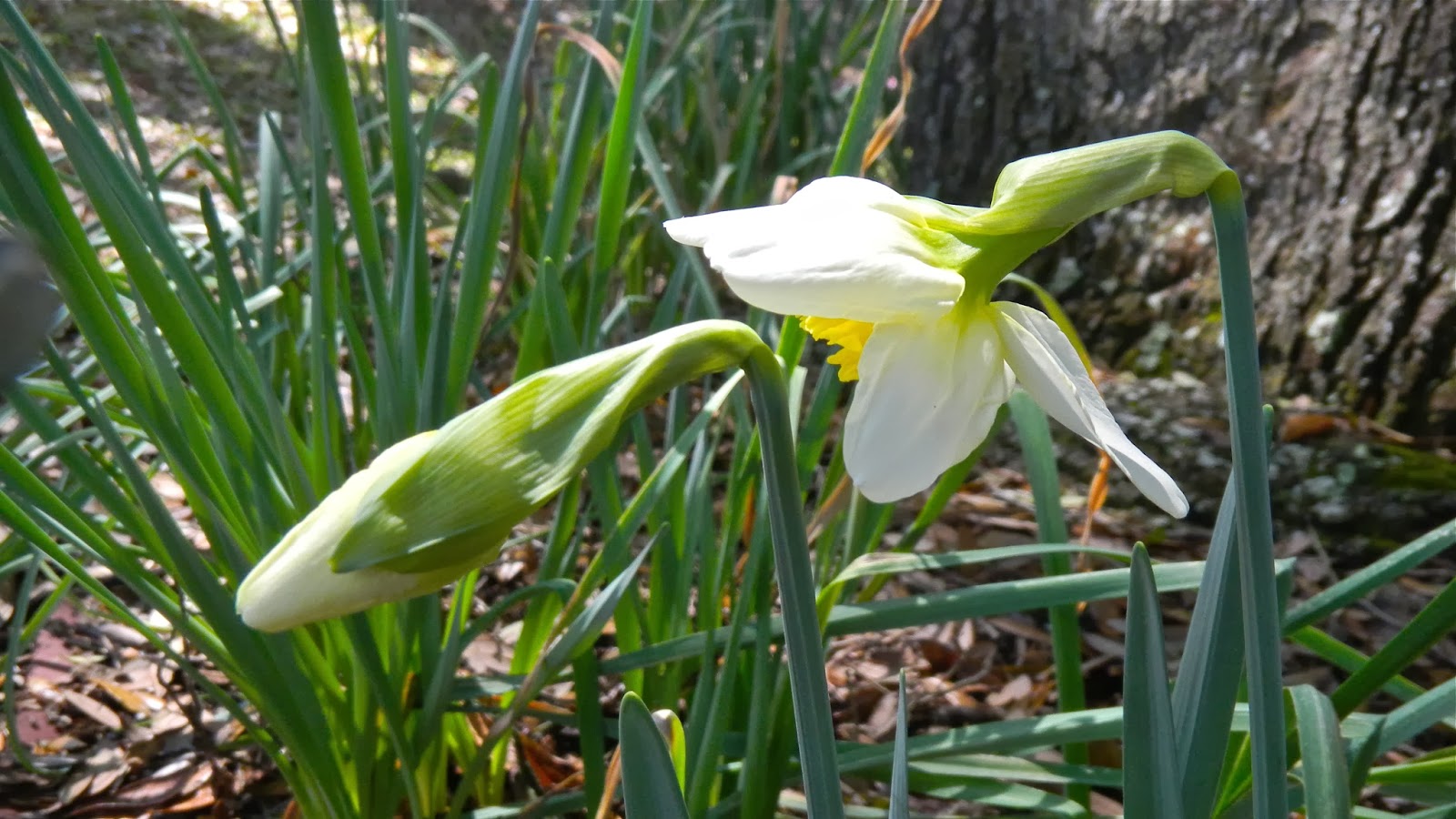
Daffodil


There's something jubilant about daffodils. Just when the bleakness of winter seems as though it will never end, they erupt into bloom.


Over the years I have planted the contents of fifty bulb sacks of  buttercream and mixed daffodils and planted smaller quantities of uncommon varieties. 

Last year very few of my daffodils bloomed. Many other area gardeners had the same disappointing results. Could the relatively warm winter of 2012 have been the culprit?


This year two fluorescent yellow daffodils popped up next to my carport in January and stayed fresh for most of the month, even enduring freezes. This month daffodils are present in patches at various locations across the yard. Not all are blooming, but enough have to remind me that spring is almost here.


Heads up!  In two short weeks pre-sales end for Those Carolina Parakeets Once Far from Extinct.  Don't delay. Order your copy today at finishinglinepress.com.

Thank you for your support.


Wednesday, January 29, 2014

Those Carolina Parakeets

January brings an increased number of birds to my backyard. Last week an infrequent visitor, the Baltimore Oriole, stopped by. I am sorry to report that the Carolina Parakeet never shows up - it became extinct early in the 20th Century. 
   
"Carolina Parakeets" by John James Audubon
Courtesy of Wikimedia Commons

I feel very blessed that such a variety of avian species choose to spend time here. It hasn't always been that way. Twenty-some years ago when I bought this suburban property, it and neighboring properties had recently lost masses of trees to Hurricane Hugo and the pine bark beetle. Except at the very back of the lot where a few wax myrtles, a red tip, and a couple of palmetto trees grew, my backyard consisted of patches of St. Augustine grass interspersed with weeds. 

Over the years I planted fruit trees, hydrangeas, azaleas, and camellias. In winter I put out suet and sunflower and thistle seeds. Gradually birds began to come seeking food on cold days. 

Here is a list of visitors that came to feed on a chilly Tuesday in this final week of January:

  • Mockingbird (See my December 2013 post for a photograph of this friend.)
  • Yellow-rumped warbler (aka Butter-butt)
  • Brown thrasher
  • Carolina chickadee
  • Tufted titmouse
  • Downy woodpecker
  • Goldfinch
  • Carolina wren
  • Palm warbler (?)
  • Blue jay
  • Mourning dove
  • Cardinal
  • Common yellow throat (New to my garden!)
  • Boat-tailed grackle
  • Red-winged blackbird
  • Bluebird (New to my garden within the past year and still infrequent, but often seen in other local neighborhoods)
  • House finch

What, you might ask, do birds have to do with gardening? For me,  birds are one of the most precious components of a garden - especially those species with brightly colored plumage or sweet songs. The trees and shrubs in my garden provide places for songbirds and others to perch, hide, nest. 

And why did I use the title "Those Carolina Parakeets"for this blog post is spite of the fact that Carolina Parakeets never visit my garden? 

I have exciting news to share. Pre-sales for my poetry chapbook Those Carolina Parakeets Once Far from Extinct began earlier this week. I am grateful to Leah Maines at Finishing Line Press for selecting my manuscript for publication and to accomplished poets Paul Allen and Susan Meyers for graciously reading it and commenting. 


The voice here is sometimes questioning, sometimes asserting, but always clean and precise. In these poems--these jewels--Pearce endears the natural world to us, and us to the natural world.

Paul Allen, author of Ground Forces and American Crawl


These smart, clear-eyed poems teach the reader some of life’s essential lessons: how it feels to be present—place by place, moment by moment—to the notes of one’s own song. Whether at a King Tut exhibit in Munich or a garden in Kyoto, the imaginative joins the analytical in the compelling attempt to decipher the day’s outer and inner weather. “My mission is to locate // the lost, the forgotten, the innovative, / the rare,” says poet Frances Pearce. Lucky reader, to take this wise, enchanting journey with her!

Susan Laughter Meyers, author of My Dear, Dear Stagger Grass and Keep and Give Away


To pre-order Those Carolina Parakeets Once Far from Extinct, please follow this link:
https://finishinglinepress.com/product_info.php?cPath=4&products_id=1973&osCsid=30gm7mesr7na1gc68rr7uhqef2

And, as always, I thank you for your support.

Tuesday, December 31, 2013

Anticipation


Hampton Park hollyhock
Hampton Park hollyhock, Charleston, South Carolina
Success in growing hollyhocks has eluded me thus far. Maybe this year?

As I anticipate what the new year will bring, I host a mini-retrospective of photographs I made over the course of the year that ends today. 

Chinese fringe flower
Here is one of several Chinese fringe flowers I bought with an Abide-A-While  gift certificate a group of generous colleagues gave me almost ten years ago. Lately I've allowed the Loropetalum to sprawl. The effect late last January? Magnificent!
Star magnolia
A year or two ago I traveled to Carolinia Nursery in North Augusta, SC to find this Star Magnolia which I brought home and planted out front. I bought it as a reminder of the Star Magnolia I saw in Kyoto, Japan soon after the March 11, 2011 earthquake. 
Daylily
Just one of several day lilies descended from ones I purchased from Roycroft Nursery in Georgetown, SC.
Rambling rose
This rambling rose I brought from eastern North Carolina where it thrived on a ditch bank.

Rambling rose
It must have been nearly twenty years ago that my daughter brought home a starter for this rambling rose after a visit to the site in central North Carolina where her father and his third wife were building a home. These roses bloom profusely each May. 


Quince growing in Camden County, North Carolina
Growing on the Eastern North Carolina farm that has been
in my family for generations, this quince is beginning to dwarf the woodshed.

Mockingbird
This mockingbird often kept me company in the garden last winter. Will it return?