Friday, November 30, 2012

Mountain Maples

Kobe, Japan

If I appear to be obsessed with autumn leaf color this year, it's because I actually am. As much as I appreciate the calm that shades of green induce, the crimsons, russets, and golden yellows of autumn are what wow me. 
Blushing maple leaves
Sometimes natural lighting cooperates during field trips. Sometimes it does not. Yesterday a mostly overcast sky provided diffused light. For the most part, the photographs I took lacked the contrast I sought and the colors my eyes experienced differed from those my camera recorded. 

The ginko trees on Kobe's Rokko Island have begun to drop their leaves
 In Kobe the trees at lower elevations have begun to drop their leaves. The foliage on the maples on Rokko-san - the mountain range rising above this city of one and a half million souls - have just begun the transition from green to vermillion. Yesterday my daughter led me up a path above Kobe's Okamoto district so that we could enjoy the early stages of color transition.

Metropolitan Kobe glimpsed through the trees
Maple leaves
 Along the way we encountered Japanese hikers, middle-aged and older, usually alone, sometimes in pairs - these hikers also there to absorb the beauty. Often they would stop to tell us about special places further up the hill. I understood nothing beyond "Konnichiwa." Fortunately, my daughter is able to understand more of the language. 
Bits of blue sky
 As we descended the hill, a pair of elderly women motioned us toward them. At first we thought they wanted us to hurry down and vacate the path. Only when we reached the spot where they stood, and allowed our eyes to focus on the scene above, did we realize their intent - to share a beautiful display of color we might have otherwise overlooked. 
The recommended view, even more lovely in real life


Wildlife

For me, the wild boars we saw during our urban expedition were a bonus.
Wild boar warning
One of several wild boars we saw, this one seemed more laid back than scary
Information in Japanese about Rokko-san: 
http://www.rokkosan.com/do/nature/
Information in English:
http://www.rokkosan.com/en/

Saturday, November 17, 2012

The Cupola House Gardens Revisited

Thursday as I drove along US Highway 17 through North Carolina I began to taste Thanksgiving flavors a week early. I wasn't actually eating anything. The leaf color, though, so thoroughly autumn, brought to mind the flavors of turkey gravy, stuffing, pumpkin pie. I could almost smell the cinnamon and nutmeg seasoning in the imaginary dessert. I salivated as I drove past leaves the color of butterscotch and persimmon.  

The Cupola House
Detouring from Highway 17, I headed to the Cupola House in Edenton, the location of the colonial revival gardens I first visited and photographed in May. Mrs. Torres at Emilio's General Store & Take Away on South Broad Street told me I was in luck - the garden volunteers had just finished weeding the previous day.   

These pink roses might seem to belong to spring or summer
According to the Cupola House Gardens brochure "Donald Parker, a landscape architect with Colonial Williamsburg, designed these gardens based roughly on the second of C.J. Sauthier's 1769 maps of Edenton."  

Cyclamen emerge amongst autumn leaves 
Claude Joseph Sauthier, a native of Strasbourg, France, trained in surveying, architecture, and landscape gardening, and was brought to North Carolina by Governor Tryon. In an essay entitled "People and Plants: North Carolina's Garden History Revisited" (British and American Gardens in the Eighteenth Century, edited by Robert P. Maccubbin and Peter Martin, 1984, The Colonial Williamsburg Foundation, Williamsburg, Virginia), author John Flowers writes "Some have suggested that the garden plots that appear in most of [the] town plans were used merely to decorate the maps...But Sauthier was too careful a draftsman and accurate surveyor to ornament his work so casually." 


Yellow - an expected color for autumn flowers

Not all of the plants placed, in accordance with Parker's design, at the Cupola House Gardens survived. Over the years garden volunteers have made changes as necessary to the landscape with a pleasing result.

A ginko tree with bright yellow leaves grows beside the house and next to Broad Street

The herb garden with pomegranate trees in the background

My Garden Update
Some species of insect that loves tomatoes also feasted on the skin of my pomegranates this year. Better luck next year, perhaps?


The leaves on my dogwood trees never turn such a vibrant red but where I live we don't usually have a cold snap before the leaves have dropped. (Crape myrtle tree on the left, dogwoods center and right.)


To learn more about Edenton's Cupola House, visit the website:  www.cupolahouse.org

Tuesday, October 30, 2012

Wandering through Butterfly Gardens

An aging Gulf Fritillary rests on a zinnia
Cypress Gardens in Berkeley County, South Carolina


Here's where I admit that I'm not a great butterfly photographer. Even if I had a more professional camera and a high quality macro lens, I wouldn't be a great butterfly photographer. These most beautiful of insects habitually flit away before I can focus or, if I'm lucky enough to focus, they take off just as I depress the shutter. Countless times I end up with a blur of motion smeared across the frame. Also, often when butterflies are out feeding, the sun is bearing down, creating too much contrast, bleaching color from blossoms and leaves. Such difficulties don't stop me from trying, yet for every decent butterfly photograph I've ever taken, there must be at least half a dozen that are embarrassingly inadequate. 

These days I use digital cameras and don't have to worry about the cost of each attempt. Back when I used a film camera, an SLR, I once dedicated an entire roll of film to trying to capture the various species of butterflies on the family farm in Northeastern North Carolina. The results? Costly and disheartening. 

 Blue Triangle butterfly visits an Ice Plant during the summer
on Rokko Island, Kobe, Japan
During my only summer visit to Japan, I never did manage to satisfactorily capture the Blue Triangle butterfly on a memory card. The one above is sadly out of focus.


But occasionally I manage a shot I'm pleased with. This one that I took of a Gulf Fritillary last week, with a new point and shoot camera, rivals any I've taken with an SLR or DSLR over the years. A tad bit too much sun perhaps, but....
Gulf Fritillary sipping nectar from a lantana in my front yard

So what plants attract butterflies? 

Butterflies need both host plants and nectar plants. The preferred host varies by species. Monarchs lay their eggs on milkweed. Some of the skippers use oak trees as hosts. Others use wisteria, members of the pea family, amaranth, cockscomb, or hollyhocks. Some swallowtails use Queen Anne's Lace and related plants. Others use magnolias. Many of the sulphurs prefer legumes as hosts. Gulf Fritillary prefer passion vines. (Perhaps this explains why I see so many Gulf Fritillaries in my yard - each year caterpillars devour the leaves of my passion flower.)

As with host plants, different butterfly species have different preferences for nectar. Here's what I'm seeing in my own garden: The Gulf Fritillaries sip nectar from any one of the three varieties of lantana I grow. Until the last blooms dropped from my red cannas earlier this month, the Cloudless Sulphur could be seen feeding there regularly, holding their wings together, flattening themselves in such a way that they appeared like bright yellow leaves. The Long-tailed Skippers seem equally happy with zinnia that's growing in a flower bed or lantana or the pot of Sceavola I bought last week.

A long-tailed skipper feeds on Sceavola in my front yard
Just over a week ago I served as a garden docent during the Charleston Horticultural Society's Gardens for Gardeners Tour. The gardens on display during the tour included those of a luxury hotel, The Sanctuary at Kiawah Island.

I regret to report that I have no photographs of The Jasmine Porch butterfly garden at The Sanctuary. When I stopped by on my way to the house to which I had been assigned, I was in a hurry and the sun shown brilliantly. In short, I forgot to pull out my camera. As I recall, the plantings included lantana and various other popular plants that attract butterflies in the South during autumn. What I clearly remember is recognizing a single Ixora coccinea. I recognized this plant because I had recently discovered it on the clearance rack at my favorite local nursery, Abide-A-While, and bought two of these jungle geraniums for my own garden. 
Ixora coccinea aka jungle geranium
Close up of Ixora coccinea


According to an informational sheet provided by The Sanctuary at Kiawah Island during the tour, the landscaping crew removed nearly all existing plant material from the butterfly garden at the beginning of this year and supplemented the soil with cotton burr compost and other amendments. Each plant in the new design is a known butterfly host or nectar plant. 

The Kiawah Island garden is a work in progress. During the year , due to problems with aphids and mealy bugs, the crew removed coreopsis. They also removed agapanthus because it attracted deer.

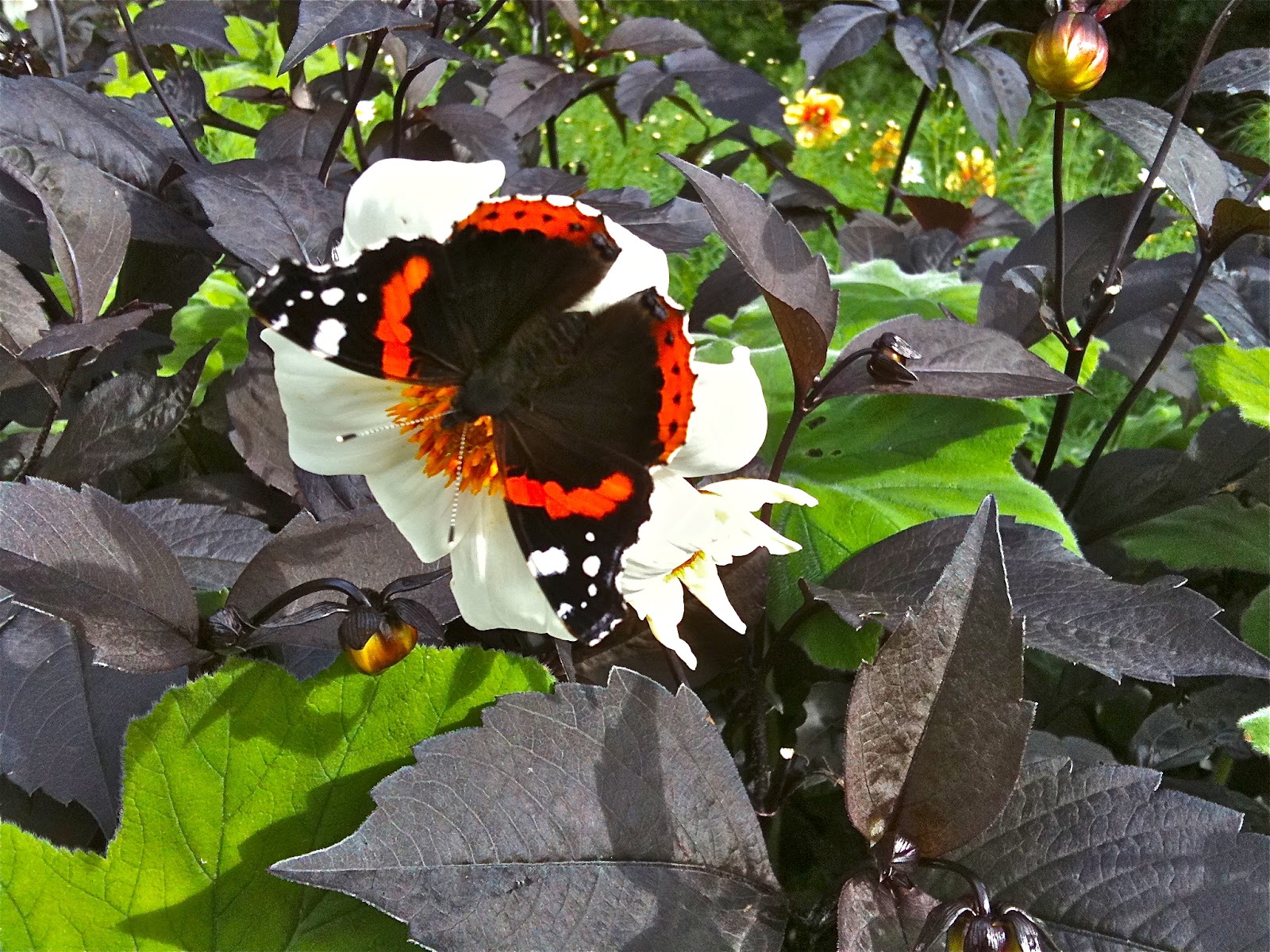
Red Admiral in Scotland's Inverewe Gardens
To see a larger version of this photograph follow the link:
http://gardenvisitor.blogspot.com/2012/08/a-week-in-inverewe-gardens.html


Inspired by viewing The Sanctuary's butterfly garden, I took a field trip to Berkeley County, South Carolina's Cypress Gardens this past Thursday to visit the butterfly house and garden there. This time I remembered to pull out my camera. 


Gulf Fritillary on Bird of Paradise inside the Butterfly House at Cypress Gardens

Butterfly Garden outside the Butterfly House at Cypress Gardens

The Butterfly House was staffed by two friendly and knowledgeable volunteers. In addition to butterflies, and host and nectar plants for the butterflies, the building housed a glass beehive, a wood duck, a painted bunting, several red-eyed doves, several small quail, and a pair of turtles. 

Emerging from the chrysalis
Butterfly House at Cypress Gardens
This Julia butterfly blends in
Butterfly House, Cypress Gardens

Cloudless Sulphur on azalea on an October day
Cypress Gardens
Gulf Fritillary on pink zinnia at Cypress Gardens
Long-tailed skipper on camellia
Cypress Gardens
Gulf Fritillary feeding on asters at Cypress Gardens 
Cloudless Sulphur on pink zinnia
Cypress Gardens
Inside the Butterfly House at Cypress Gardens


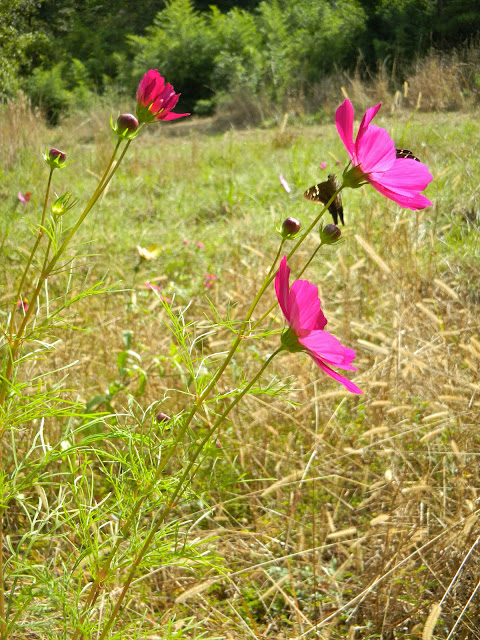
A Long-tailed Skipper waiting for a turn at a cosmos
Cypress Gardens

Cloudless Sulphur tucked inside a hibiscus blossom
 Butterfly House at Cypress Gardens


Monarch on Sullivan's Island, South Carolina during autumn migration

Author Mary Alice Monroe, who often addresses environmental issues in the novels she writes, has written about Monarch migration in The Butterfly's Daughter. Not only did she raise awareness of the Monarch's diminishing habitat, but during a book launch event she gave milkweed seed to readers to help combat that loss. Monarch butterflies also appear in Flight Behavior, Barbara Kingsolver's new novel, which deals with climate change.

For more information about Cypress Gardens, visit their website:
Laying eggs? Gulf Fritillary inside the Butterfly House at South Carolina's Cypress Gardens

Tuesday, October 16, 2012

Blazing Autumn

Autumn color at the Kobe Municipal Arboretum in Japan
Russet, golden, deep wine, butternut, brick, lime, tan. These are but a few of the colors that leaves in the northern hemisphere turn during the last three months of the calendar year.

Here in the Lowcountry, we don't often get a colorful autumn and most of our leaf color arrives in late November. Our ubiquitous live oaks drop their leaves in the spring and never sport the bright colors of Japanese maples or ginkgo trees. The native dogwoods and Virginia creeper provide a bit of color but not enough to make it appear that we have four distinct seasons.
Autumn leaves in Savannah, Georgia on Thanksgiving Day 2010


A few days ago, I drove through the North Carolina mountains on my way to Kentucky and Tennessee. During the drive up, I didn't see much leaf color. The single stretch where trees with brilliant yellow leaves lined the interstate highway happened to be where the road is most narrow. Tractor-trailer trucks whizzed along far too close to one another in the right lane and the driver of the large pickup truck behind my car in the left lane seemed to want me to drive more than ten miles an hour above the speed limit. No leaf peeping for me!  
Autumn color at the North Carolina Welcome Center on I-40
near the Tennessee state line early yesterday afternoon
Thursday morning as I walked along Main Street in Danville, Kentucky I viewed the trees and ornamental plantings, as around me townspeople, and visitors in town for the Vice Presidential debate, chatted on Main Street, enjoying a crisp, clear day. The ginko trees that line this charming town had just begun to go from green to yellow.  Maples blushed, but many continued to contain branches that bore partially green leaves. Purple petunias and orangey geraniums brightened up the exterior of a real estate office while pots of yellow or lavender mums stood near other doorways.    
Fallen leaves near the labyrinth in Danville, Kentucky
Ginkgo trees line Main Street in Danville, Kentucky
On the day of the Vice Presidential debate at Centre College, the leaves 

on  the sunlit side of the street had just begun the transition to yellow
Friday morning driving down US 127 on my way to Nashville, I witnessed gorgeous fall colors. The trees formed mosaics on the sides of hills. On Sunday on I-65, I saw trees growing from natural rock walls. Sometimes they alternated in color as if someone had implemented a landscaper's design: yellow, red, butternut, yellow, red, butternut.    

On a walk though the woods with a friend in Tennessee, I saw plenty of colorful dropped leaves. Black walnuts, hickory nuts, and tiny persimmons also were scattered along the path. As we approached Sycamore Creek, a large flock of blackbirds (starlings, perhaps) flew in and settled in the tops of trees. 

One of my favorite past-times, during autumn and winter, is watching flocks of blackbirds gather and disperse, gather and disperse. Their calls might sound raucous, but their movement is like a symphony conducted by God.  

Red maples at Tofuku-ji in Kyoto, Japan
Tofuku-ji

Last year I had the good fortune of visiting Tofuku-ji in Kyoto during early December. I was there to see the moss checkerboard, but because the peak fall color came slightly later than usual, I also saw the valley of red maples. So many tourists filled Tofuku-ji on that day that security guards were needed to maintain order in the temple grounds. 
Maple leaves in Kobe, Japan
Red maples in Mino, Osaka Prefecture, Japan
Ginkgo leaves in Kobe, Japan
Kobe Municipal Arboretum, Kobe, Japan
Over the past eighteen months I've planted a ginkgo tree, two Japanese maples (one red), and an ornamental cherry in my front yard. Within a year or two perhaps my Lowcountry autumns will  be more colorful.
These leaves, fallen from ornamentals at a Raleigh, North Carolina hotel,
 I found so beautiful that the next  year I made a detour just to see the fall color
Because You Asked
All photographs in each of my Traveling Gardener blog posts were taken by me (Frances J. Pearce) unless otherwise noted. 

Thank you for stopping by. If you enjoy reading this blog, please consider becoming a subscriber or follower.

Fallen leaves in multiple colors on the outskirts of Danville, Kentucky